OMS Meaning Text: Full Form, Uses, Examples & Explanation
The acronym “OMS” has multiple meanings across different fields. Understanding the OMS text is crucial, especially in a rapidly evolving digital landscape where clarity in communication is king.
This article will unpack the full form of OMS, delve into its various uses, and provide concrete examples to enhance your understanding. By the end, you’ll not only grasp what OMS means but also recognize its significance in your everyday interactions.
What does OMS Meaning Text?
OMS, which stands for “Oh My Stars,” is a playful and lighthearted expression often used in texting and online conversations. It serves as a gentler alternative to the more commonly known “OMG” (Oh My God), making it suitable for various contexts, especially when the sender wants to convey surprise, excitement, or mild shock without the weight of more intense phrases.
- Surprise: “OMS, I can’t believe you did that!”
- Excitement: “OMS, that’s amazing news!”
- Shock: “OMS, did you see the finale?”
- Playful drama: “OMS stop, that’s too funny.”
Origin and Background of OMS
The Origin and Background of OMS traces back to a time when language was rich and expressive, yet society sought alternatives to harsher exclamations. “Oh My Stars” was a common expression that conveyed surprise without the weight of profanity, often reflecting social norms that favored gentility in conversation.
This quaint phrase frequently graced literature and spoken dialogue, evoking a sense of wonder or shock in a manner that felt both innocent and whimsical.
How OMS Became Popular Online
The rise of acronyms in digital communication has played a significant role in the popularity of phrases like “Oh My Stars,” which transformed into the more concise “OMS.” As communication shifted towards brevity, particularly on platforms like Twitter and messaging apps, people began to adopt and adapt expressions that conveyed emotions quickly and effectively.
OMS, with its lighthearted connotation, provided a softer alternative to more intense reactions, making it ideal for casual conversations and social media interactions.
Common Usage and Contexts of OMS
The acronym OMS Meaning Text has swiftly carved a niche in online conversations, particularly in spaces where tone is paramount. In forums like Twitter and TikTok, it embodies an exciting blend of surprise and disbelief, allowing users to convey their reactions succinctly. Instead of laboring through elaborate expressions, individuals can simply drop an OMS to showcase their amusement or shock.
OMS in Texting and Online Conversations
OMS Meaning Text and online conversations serve as a dynamic shorthand for emotional nuance, allowing users to convey complex feelings in just three characters. This succinct form of expression not only saves time but also enhances clarity in digital communication. By using OMS as a standalone reply or at the beginning of a sentence, individuals can instantly set the emotional tone, deepening the connection with the recipient.
Examples:
- “OMS, that’s incredible news!”
- “OMS, I totally forgot about that.”
- “OMS, you’re kidding me!”
OMS in Social Media and Internet Slang
The rise of OMS Meaning Text in social media reflects a broader trend towards brevity and immediacy in communication. It serves as a shorthand for shock or disbelief, seamlessly fitting into the fast-paced environment of memes and viral content. Imagine scrolling through a jaw-dropping video of a celebrity mishap or a bizarre animal encounter; seeing “OMS” in the comments encapsulates a collective gasp, amplifying the emotional response without requiring extended commentary.
It’s especially popular in:
- Comment threads
- Reaction posts
- Viral content discussions
- Fan communities
OMS in Gaming Chats and Online Communities
In the whirlwind of gaming chats and online communities, the acronym OMS, short for “Oh My God, Seriously?” has emerged as a staple for players navigating the emotional rollercoaster of gameplay. Every unexpected plot twist or jaw-dropping fail can ignite a flurry of responses, with OMS capturing the collective astonishment and humor that defines the gaming experience.
Typical uses include:
- Reacting to clutch victories
- Surprising in-game events
- Teammate mistakes or funny moments
- Live stream chat reactions
You May Also Like: WYO Meaning
OMS in Professional, Business, or Technical Settings
In professional, business, or technical settings, the use of OMS (Oh My Stars) remains largely absent from formal communication channels. Emails, reports, and presentations strive for clarity and precision, often steering clear of slang or colloquial expressions to uphold a tone of professionalism.
Appropriate:
- Team group chats
- Informal colleague conversations
Not appropriate:
- Client emails
- Official documents
- Corporate presentations
Tone and Intent Behind OMS
The tone and intent behind OMS is a refreshing departure from the often blunt and brusque styles of communication we encounter daily. By embracing a light, friendly, and wholesome approach, OMS invites readers into a space where genuine connection flourishes.
This warmth not only eases the exchange of ideas but also fosters a community where emotions can be shared and felt without fear of judgment or misinterpretation.
- Sound polite rather than intended.
- Keep conversations playful
- Express excitement safely
- React without offending anyone
How and When to Use OMS
When it comes to casual conversations, knowing *how and when to use OMS* can elevate your interactions significantly. This phrase shines in moments of shared excitement or amusement, such as when a friend shares delightful news about a promotion or a funny incident that caught them off guard.
- Someone shares exciting news
- You’re reacting to a funny video or meme
- A friend tells you something surprising
- You want a softer reaction than “OMG..”
- You’re chatting in a relaxed group conversation
When to Avoid Using OMS
When considering how and when to use OMS, it’s essential to recognize its limitations. In professional emails, academic papers, or formal presentations, inserting internet slang can undermine your credibility. An audience expecting a serious tone may find OMS off-putting or dismissive, potentially hindering your message. The nuances of respect and professionalism often demand a more traditional approach to language.
- Business or client emails
- Job applications or interviews
- Academic assignments
- Formal presentations
- Serious or sensitive discussions
Examples of OMS in Text Conversations
Here are simple, real-life style examples showing how OMS appears in chats:
- Friend Chat
A: “I got concert tickets for us!”
B: “OMS, that’s amazing.” - Family Chat
“OM, I didn’t know you were visiting this weekend!” - Funny Reaction
“OMS, I can’t stop laughing at this video.” - Shock/Drama
“OMS wait… You actually said that?” - Gaming Chat
“O MS, how did we win that match?!”
Different Variations of OMS and Their Meanings
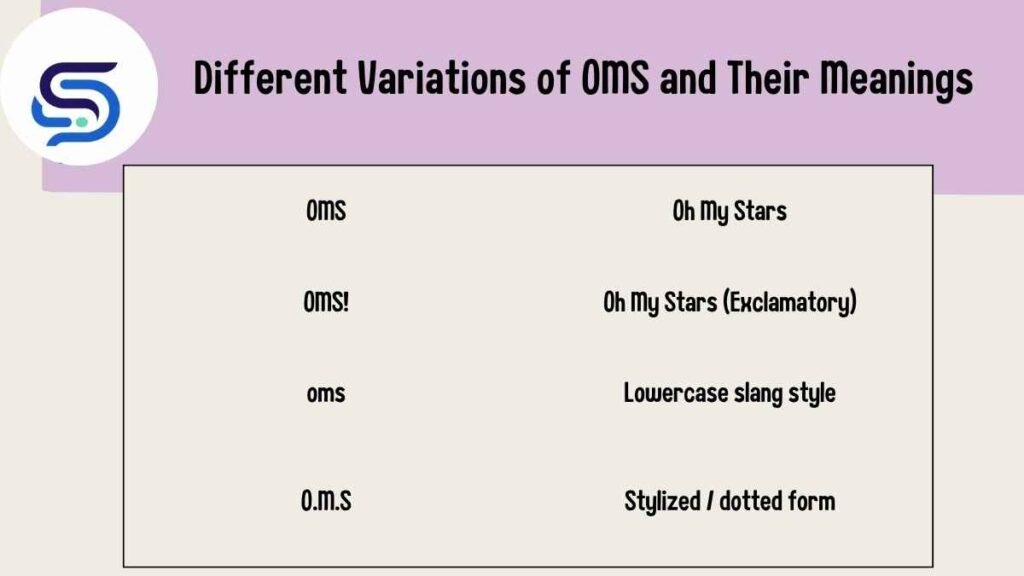
| Variation | Full Form / Style | Meaning & Usage Context |
| OMS | Oh My Stars | Standard form used to express surprise, excitement, or shock in casual chats. |
| OMS! | Oh My Stars (Exclamatory) | Shows stronger emotion or sudden excitement. |
| oms | Lowercase slang style | Casual, quick reactiois n is often used in fast texting. |
| O.M.S | Stylized / dotted form | Dramatic or playful emphasis, sometimes used humorously. |
| OMSSS | Extended spelling | Heightened excitement, like stretching a reaction vocally. |
How to Respond When Someone Uses OMS
When someone uses “OMS” in a message, they’re typically conveying a mix of surprise or excitement. A great way to respond is by acknowledging their enthusiasm with a light-hearted comment or a shared reaction. For example, you could say something like, “I know, right? I couldn’t believe it either!” This not only validates their feelings but also enhances the connection between you.
Ways to reply:
- Acknowledge the excitement! “Right?! I couldn’t believe it either.”
- Add more details! “OMS I, know! It happened so fast.”
- Share the moment! “Glad you’re excited too!”
- Respond playfully! “Haha, O, MS, wait till you hear the rest.”
- Mirror the tone! “OMS t,,h at’s so cool!”
Related Topic: TS Meaning
Similar Slang Terms and Alternatives
The world of online communication is rich with slang, and terms like “OMS” (Oh My Sh*t) tap into a broader family of reaction acronyms that convey surprise or disbelief. Alternatives like “OMG” (Oh My God) and “WTF” (What The F*ck) serve similar purposes but differ in emotional intensity and context.
While “OMG” is often lighter and can be used in more casual settings, “WTF” carries a more aggressive tone, making it ideal for expressing shock or frustration. Understanding these nuances can help users tailor their responses, aligning their emotional output with the gravity of the situation.
Casual Alternatives
Casual alternatives are perfect for texting friends, family, or social media chats.
Examples:
- “OMG!”
- “No way!”
- “Stoppp”
- “I’m screaming!”
- “That’s wild!”
- “You’re kidding!”
Formal Alternatives
In semi-formal conversations, you may want to express surprise without slang.
Examples:
- “That’s surprising.”
- “I’m amazed to hear that.”
- “How exciting!”
- “That’s quite impressive.”
- “I didn’t expect that.”
Professional Alternatives
Professional settings require neutral, respectful language instead of acronyms.
Examples:
- “That’s excellent news.”
- “I appreciate the update.”
- “That’s very impressive.”
- “Thank you for sharing this.”
- “I’m pleased to hear that.”
When to Avoid It
Avoid using OMS when:
- You’re in a formal or professional conversation
- The topic is serious, sensitive, or emotional
- The person you’re texting may not understand slang
- The tone requires clarity, not casual expressions
- You’re communicating with older individuals less familiar with internet slang
More: IFYKYK Meaning
Conclusion
Understanding the OMS Meaning Text, which stands for Operational Management System, provides valuable insights into its significant role in today’s business landscape. From enhancing efficiency to streamlining processes, the uses and examples highlight its practicality across various industries.
As organizations strive for optimization, leveraging OMS can lead to improved decision-making and increased productivity. Moreover, as technology continues to evolve, the applications of OMS are likely to expand further. Embrace the potential of an Operational Management System and consider how it can benefit your operations today.
FAQs
What does OMS stand for?
OMS stands for “Order Management System,” a software solution that helps businesses manage and process orders efficiently.
What are the primary uses of an OMS?
An OMS is used for tracking orders, managing inventory, processing payments, and coordinating shipping logistics.
Can you provide examples of industries that use OMS?
Industries such as e-commerce, retail, logistics, and manufacturing commonly utilize OMS to streamline their order processes.
How does an OMS improve business efficiency?
By automating order processing and inventory management, an OMS reduces manual errors, speeds up fulfillment, and enhances customer satisfaction.
What features should I look for in an OMS?
Key features include real-time inventory tracking, integration capabilities with other systems, reporting tools, and user-friendly interfaces.