
120+ Biology Words that start with y: Best Complete Guide
While the letter ‘Y’ is one of the least-used letters in the English language, it houses a fascinating array of biological terminology. In this complete guide, we’ll explore over 130 biology words that start with Y, revealing their meanings and significance in various scientific contexts.
Understanding these terms will not only enhance your vocabulary but also deepen your appreciation of biological concepts. Whether you’re a student, teacher, or just a curious mind, this guide will serve as your essential resource for expanding your knowledge.
Biology Words That Start With Y
In the realm of biology, terms beginning with ‘Y’ may not be as abundant, but they carry significant weight. One of the most intriguing is “yeast,” a microorganism critical to fermentation processes. Beyond bread and beer, yeast plays a vital role in biotechnology, where its genetic mechanisms are harnessed for research and the production of biofuels. This single-celled fungus serves as a model organism in studies of genetics and cell biology, illuminating the pathways that govern life itself.
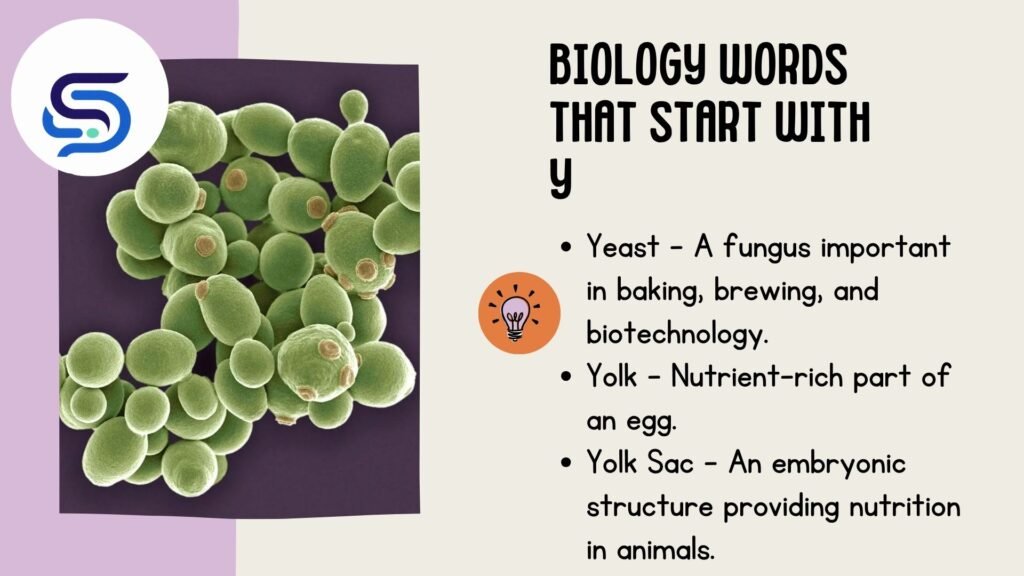
- Yeast – A fungus important in baking, brewing, and biotechnology.
- Yolk – Nutrient-rich part of an egg.
- Yolk Sac – An embryonic structure providing nutrition in animals.
- Y-Chromosome – The male sex chromosome in humans and many animals.
- Yersinia pestis – The bacterium that causes plague.
- Yellow Fever – A viral disease spread by mosquitoes.
- Yew Tree – A plant studied in biology and medicine (source of cancer drug Taxol).
- Yam – A starchy root vegetable important in plant biology.
- Yeast Infection – A disease caused by the overgrowth of Candida fungus.
- Yellow Bone Marrow – Fat-storing tissue inside bones.
- Yolk Protein (Vitellogenin) – A protein that supplies nutrients to embryos.
- Y-Linked Traits – Traits controlled by genes on the Y chromosome.
- Yersinia enterocolitica – A bacterium causing foodborne illness.
- Y-shaped Antibodies – Immune system proteins that fight infections.
- Youth Stage – The early developmental stage of an organism.
Biology Science Words That Start With Y
One intriguing biology words that start with Y is yeast, a vital organism in both ecological systems and human industry. Yeast, a unicellular fungus, plays a crucial role in fermentation processes, enabling the production of bread, beer, and wine. Beyond culinary delights, yeast serves as a model organism in genetic research, offering insights into cellular processes and metabolic pathways. This small yet powerful organism underscores the interconnectedness of biology and everyday life, revealing how microorganisms can shape human culture and industry.
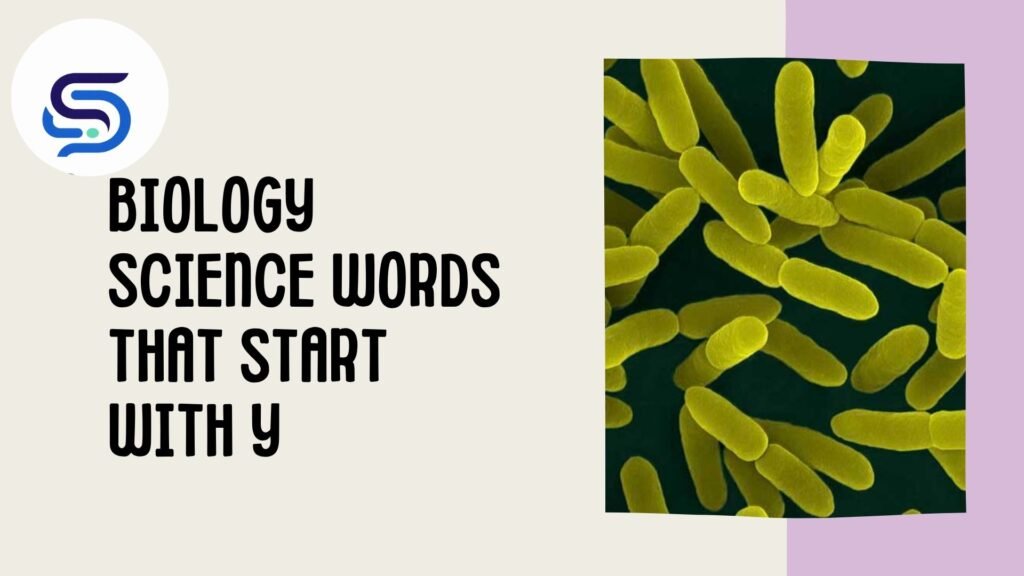
- Yeast Cell – A model organism in genetics research.
- Yawn Reflex – An involuntary breathing response.
- Yersinia – A genus of bacteria causing diseases.
- Yolk Protein – Supplies energy to developing embryos.
- Yellow Fever – A viral disease transmitted by mosquitoes.
- Yolk Platelet – Stores nutrients in egg cells.
- Yolk Granules – Nutrient-filled particles in eggs.
- Yolk Syncytium – A structure in early embryo development.
- Yeast Fermentation – A biological process producing alcohol.
- Yolk Membrane – Encloses and protects the yolk.
- Yolk Nucleus – Part of egg cell development.
- Yeast GenA: a: a biological study of heredity using yeast.
- Yawn Contagion – A social biological phenomenon.
- Yolk Absorption – Process in embryo nutrition.
- Yolk Pigment – Gives color to egg yolks.
- Yolk Utilization – Use of socialized nutrients by embryos.
Best Biology Words That Start With Y
- YAG Laser
- Yak
- YAP1
- Yarrowia
- Yarrowia Lipolytica
- Yatapoxvirus
- Yawning
- Yeast
- Yeast Artificial Chromosome
- Yeast Autolysate
- Yeast Display
- Yeast Two-Hybrid Screening
- Yellow Fever Virus
- Yellow Fluorescent Protein
- Yellow Head Virus
- Yersinia
- Yersinia enterocolitica
- Yersinia Pestis
- Yersinia pseudotuberculosis
- Yohimbine
- Yorkshire Pig
- Yorkshire Terrier
- Young Modulus
- YOYO-1
- Yucatan Micropig
- Yucca
- YWHAE
- YY1
- Y Box Binding Protein 1
- Y Chromosomal Inheritance
- Y Chromosome
- Y Chromosome Haplogroup
- Y Chromosome Microdeletion
- Y-Maze Test
- Y-STR
Related: 250+ Science Words That Start With C
Science & Biology Words That Start With Y
- Yeast
Meaning: A single-celled fungal microorganism capable of fermenting carbohydrates, used extensively in baking, brewing, and biotechnology research.
Examples:
Scientists use yeast as a model organism to study fundamental cellular processes.
The baker added active dry yeast to the dough to make it rise properly.
- Y-chromosome
Meaning: One of the sex chromosomes in mammals, determining male characteristics when paired with an X-chromosome in the typical XY sex-determination system.
Examples:
The Y-chromosome is passed exclusively from father to son in humans.
Genetic studies of the Y-chromosome help trace paternal lineages throughout human evolution.
- Yellow bone marrow
Meaning: A type of bone marrow consisting primarily of fat cells that replaces red marrow in the shafts of long bones in adults.
Examples:
Yellow bone marrow can convert back to red marrow during severe blood loss or anemia.
The anatomy professor pointed out the yellow bone marrow visible in the femur cross-section.
- Yolk
Meaning: The nutrient-rich center of an egg that provides food for the developing embryo, primarily composed of proteins, lipids, and minerals.
Examples:
The yolk contains essential nutrients like vitamin D and choline for embryonic development.
The embryologist carefully separated the yolk from the albumen for further analysis.
- Yolk sac
Meaning: An embryonic membrane that forms one of the extraembryonic membranes, serving as the first site of blood cell formation in vertebrate development.
Examples:
The yolk sac provides nourishment to the embryo before the placenta develops.
Ultrasound imaging at seven weeks showed a clearly visible yolk sac in the gestational sac.
- Yearling
Meaning: An animal that is between one and two years old, a term commonly used in zoology and wildlife management.
Examples:
The yearling deer was developing small antler buds as it matured.
Wildlife biologists tagged the yearling bears to track their movements through the forest.
- Yunnanozoan
Meaning: An extinct chordate animal from the early Cambrian period found in the Yunnan Province of China, significant in evolutionary biology.
Examples:
Yunnanozoan fossils have provided insights into early vertebrate evolution.
The paleontologist’s discovery of an intact Yunnanozoan specimen revolutionized understanding of early chordate anatomy.
- Y-linked inheritance
Meaning: A pattern of inheritance for genes located exclusively on the Y-chromosome, resulting in traits that are passed only from father to son.
Examples:
Y-linked inheritance explains why certain male-specific traits appear in every generation of male offspring.
The geneticist determined that the rare condition exhibited Y-linked inheritance patterns in the family pedigree.
- Yucca
Meaning: A genus of perennial shrubs and trees native to hot and dry regions, known for their distinctive rosettes of rigid, sword-shaped leaves.
Examples:
Yucca plants have evolved a mutualistic relationship with specific moth species for pollination.
The botanist studied how yucca roots adapt to survive in desert environments with minimal rainfall.
- Yellow fever
Meaning: An acute viral hemorrhagic disease transmitted by infected mosquitoes, causing jaundice, fever, and sometimes organ failure.
Examples:
Yellow fever vaccination is required for travelers to certain regions of Africa and South America.
The epidemiologist traced the yellow fever outbreak to a population of Aedes aegypti mosquitoes.
- Yogurt
Meaning: A fermented dairy product created by bacterial fermentation of milk by Lactobacillus and Streptococcus thermophilus bacteria.
Examples:
Yogurt contains beneficial probiotic bacteria that support gut microbiome health.
The microbiologist studied how different strains of bacteria affect the texture and flavor of yogurt.
- Yarrow
Meaning: A flowering plant (Achillea millefolium) with medicinal properties, containing compounds with anti-inflammatory and antimicrobial effects.
Examples:
Yarrow extracts were tested for their effectiveness against bacterial skin infections.
The ethnobotanist documented how indigenous communities use yarrow to treat wounds and reduce fever.
- Yawn
Meaning: A reflexive respiratory action involving deep inhalation followed by exhalation, often associated with drowsiness or boredom, studied in behavioral biology.
Examples:
The neurologist researched how yawning may help cool the brain and improve alertness.
Contagious yawning is observed in social mammals and may be linked to empathy.
- Yellow jacket
Meaning: A social wasp of the genus Vespulaor Dolichovespula, characterized by bright yellow and black markings and a painful sting.
Examples:
Yellow jackets are important predators that help control populations of pest insects.
The entomologist observed that yellow jacket colonies become more aggressive in late summer as food sources diminish.
- Yolk plug
Meaning: A structure formed during embryonic development when large yolk-filled cells block the blastopore during gastrulation.
Examples:
The developmental biologist photographed the yolk plug to document this critical stage of amphibian embryogenesis.
In frog embryos, the visible yolk plug indicates that gastrulation is underway.
- Yield (biological)
Meaning: The amount of product obtained from a biological process, such as the biomass produced by a crop or the amount of metabolite synthesized by microorganisms.
Examples:
The agricultural scientists worked to improve the yield of drought-resistant wheat varieties.
Genetic modifications increased the enzyme yield from the bacterial fermentation process.
- Ytterbium marker
Meaning: A rare earth element used as a biological marker in certain laboratory studies to track cellular processes and protein movements.
Examples:
Ytterbium markers allowed researchers to follow calcium transport through cell membranes.
The biomedical researcher used an ytterbium marker to distinguish transplanted cells from host tissue.
- Yellow marrow
Meaning: Another term for yellow bone marrow, the fatty tissue found in the hollow interior of bones that can convert to red marrow when needed.
Examples:
During severe blood loss, yellow marrow can transform into red marrow to increase blood cell production.
The medical illustration clearly showed the distribution of yellow marrow in adult long bones.
- Y-maze
Meaning: A laboratory apparatus shaped like the letter Y, used in behavioral experiments to test decision-making and spatial memory in animals.
Examples:
The neuroscientist designed a Y-maze experiment to assess memory deficits in mice with Alzheimer’s disease.
The rat’s performance in the Y-maze indicated strong working memory capabilities.
- Yellow spot
Meaning: The macula lutea, a yellowish area in the center of the retina containing the fovea centralis, is responsible for central, high-resolution vision.
Examples:
The ophthalmologist examined the yellow spot for signs of macular degeneration.
Damage to the yellow spot can severely impact detailed vision while peripheral vision remains intact.
Biology Glossary of Science Terms that start with Y
- Yolk: Yolk is the internal part of a mammal egg enclosed by white liquid, which is rich in proteins and fat. In simple words, the yolk is the nutrient-rich portion of an egg that mainly helps in the development of the embryo. Egg yolks contain vitamin D, calcium, manganese, iron, selenium, phosphorus, zinc, and copper.
- Yeast: Yeast is a member of the fungi family with a single cell. It is useful in the fermentation of sugar and results in the formation of carbon dioxide and alcohol. It is very handy for commercial use in order trto raise doughhile baking and to make alcoholic beverages.
- Yellow Fever: Yellow fever is an infectious disease with symptoms including muscle pain, high fever, chills, yellow skin, headache, etc. The other names of yellow fever are Bronze John, Yellow Plague, and Yellow Jack. The main cause of this flu-like disease is mosquitoes. Jaundice is another major symptom of this disease apart from the above-mentioned symptoms. Jaundice is nothing but yellowing skin with a high fever. Hence, the name given is yellow fever. South America and Africa are the countries where this disease is widespread.
- Yangsheng: Yangsheng is the most prominent word in Chinese medicine and religion. The meaning of yangsheng is caring for life, which aims to maintain youthfulness and, ffurtherr further living.
- Yolk Platelets: Yolk platelets are the membrane-bound structures found in the egg yolk of reproducing organisms and typically in certain types of fish. You can see them in amphibians as well as in fish.
- Yolk Sac: The yolk sac is a significant structure found on the outer layer of the embryo and plays aanan important role the further development of the embryo. The main function is: it takes part in giving nutrition to the embryo until the placenta comes into the picture. The yolk sac is a positive and healthy sign of a healthy pregnancy.
- Yolk Plug: It is a huge mass of vegetal or endoderm cells that happens during the ventral lip formation of the amphibian blastopore during gastrulation.
- Y linkage: The hereditary array of genes present on the Y chromosome is called Y-linkage. It is equivalent to X-linkage.
- Y-linked disease Y-linked disease is an inherited health condition where a particular gene on the Y chromosome mutates. That means there is a disorder in the array og genes present on Y chromosomes. Y chromosomes only exist in males. So, the disease has a high potential to be inherited by males from one generation to the next generation. For example, father to son to grandson.
- Yeast Two Hybrid: It is a combination of two proteins,s i.e., one is a bait protein accompanied by a transcription factor, whereas the other one is a prey protein which fuses with a related transcription factor. When these two proteins come closer and fuse, a precise signal is delivered, which indicates that the interaction has taken place.
- Yin-Yang Probe: Yin-Yang probes are the double-stranded probes or displacing probes useful for the detection of specific nucleic acids in gene mutations. Its detailed design supports a number of diagnostic kits and makes them cost-effective and handy. Hence, it is important to diagnose any number of infectious diseases, food pathogens, genetic disorders, cancer, hematologic malignancies, solid-tumor cancers, etc. Yin-Yang probes encompass DNA, RNA, and combinations of both, along with non-natural nucleotide and nucleotide linkages.
- Yellow Enzyme: Yellow enzymes are the flavoenzymes that perform biochemical reactions such as oxidation-reduction reactions. Biochemical reactions are reactions that involve breathing and respiration by collecting enough oxygen. To perform these biochemical reactions, yellow enzymes catalyze these reactions to help body cells breathe and respire easily. Old and new yellow enzymes are the first flavoenzymes in the scientific world.
- Yeast Artificial Chromosome (YAC): YAC is a genetically or human-engineered cloning vector that has the largest insert capacity. Yeast DNA is the birthplace for these chromosomes to originate. Jef Boeke, Langone Medical Centre at New York University, was the one who discovered YACs in March 2014. YACs have the capacity to clone DNA stretches of 50 to over 2000 kb and up to 1Mb in yeast cells.
- Y-type ion: In mass spectroscopy, we see several types of N-terminal polypeptide fragments as a result of α-carbon and its neighboring α-carboxy carbon bond cleavage. Apart from N-terminal fragments, C-terminal fragments are also visible. Y-type ions, such as C-terminal iminium ions, are the result of bond cleavage between the arbon and its neighboring α-carboxy carbon.
- Yin-Yang hypothesis: Every single organism on this Earth,,ight from micro to macro organisms, cells are the basic foundation to form whole body tissues. Yin-Yang’s hypothesis is the theory of two opposite forces. These two forces are reciprocally reliant and interchangeable in order to maintain balance in life. In the same way, the Ying-Yang hypothesis is a bidirectional cellular process that regulates the biological model of cyclic nucleotides.
Read More: 230+ Science Words That Start With G
Biology: Science Words With Y
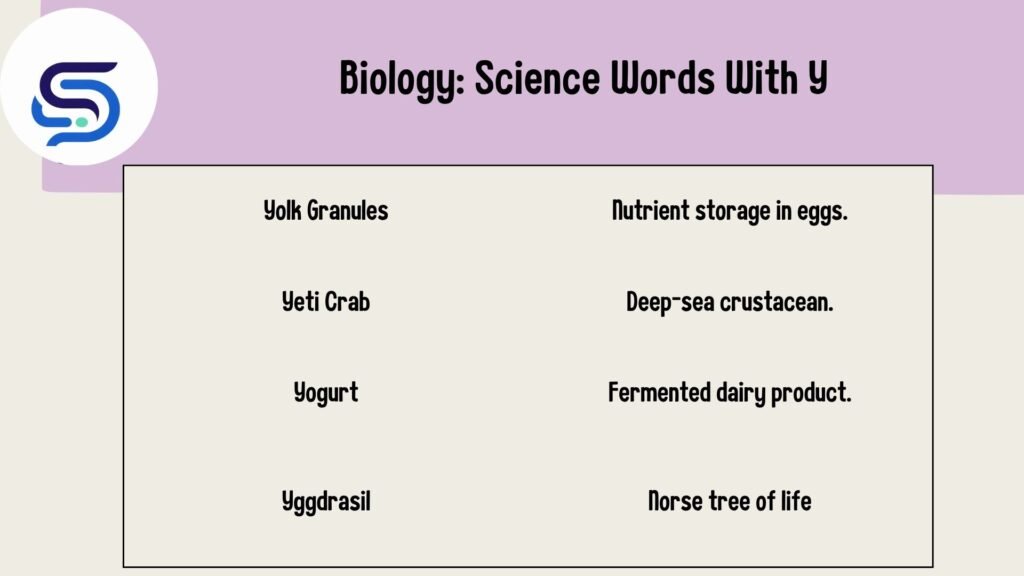
| Yolk Granules | Nutrient storage in eggs. |
| Yeti Crab | Deep-sea crustacean. |
| Yogurt | Fermented dairy product. |
| Yggdrasil | Norse tree of life |
| Yautia | Tropical root crop. |
| Yarrow | Medicinal plant. |
| Yabby | Freshwater crustacean. |
| Y-maze | Behavioral test apparatus. |
| Yean | Give birth (goats/sheep). |
| Yucca Moth | Pollinating insect. |
| Yellowhammer | Species of bird. |
| Yew Taxine | Toxic alkaloid. |
| Yodel | Vocal call (animal behavior). |
| Yclept | Archaic term for “named.” |
| Yin | Concept in Chinese medicine. |
| Yuck Factor | Aversion response. |
| Yaffle | Woodpecker’s call. |
| Yolk | Nutrient-rich part of an egg. |
Conclusion
Our comprehensive guide on biology words starting with the letter “Y” has equipped you with a diverse vocabulary essential for your studies or teaching. Understanding these terms not only enhances your grasp of biological concepts but also aids in effective communication within the scientific community.
From “yolk” to “yeast,” each word plays a significant role in various biological processes and disciplines. As you continue to explore the vast world of biology, keep this guide handy for quick reference and inspiration. Dive deeper into your studies and enrich your learning journey today!
FAQs
What are some common biology terms that start with the letter Y?
Some common terms include Y chromosome, yeast, and yellow jessamine.
How is the Y chromosome different from the X chromosome?
The Y chromosome determines male sex in humans and contains fewer genes than the X chromosome.
What role do yeasts play in biology?
Yeasts are crucial for fermentation processes and are used in baking, brewing, and scientific research.
Are there any significant plant species that start with the letter Y?
Yes, yellow jessamine (Gelsemium sempervirens) is a notable flowering plant.
Can you explain what “yolk” is in biology?
Yolk is a nutrient-rich substance found in egg cells, providing essential nutrients for developing embryos.