FRL Meaning Text: Definition, Uses, Origin & Examples Explained
A simple three-letter acronym can transform your online conversations. In this article, we’ll dive into the FRL meaning text, exploring its definition, uses, and fascinating origins.
Understanding this popular abbreviation is crucial for navigating today’s digital communication landscape. By the end, you’ll not only grasp what FRL means but also how it can enhance your interactions online.
What Does FRL Meaning Text?
FRL stands for “For Real, Like,” and is commonly used in text messaging and online communication to convey sincerity or authenticity. It’s often used when someone wants to emphasize that they are being serious about a situation or feeling. This phrase is popular among younger audiences and can help to punctuate messages, making them feel more relatable and genuine.
Origin and Background of FRL
The origin and background of FRL illustrate a fascinating evolution in language driven by technological advancements and cultural shifts. As texting became the primary mode of communication, especially among younger generations, the need for brevity surged.
FRL emerged as an efficient shorthand for conveying authenticity or agreement, encapsulating deeper emotions within just three letters. This linguistic evolution mirrors the broader trend of digital communication, where time and space constraints foster creative expression.
How FRL Became Popular Online
The abbreviation “FRL,” often interpreted as “for real,” surged in popularity alongside the rise of digital communication platforms. As texting and social media evolved into primary modes of interaction, users sought ways to convey messages swiftly and efficiently.
The casual nature of these platforms encouraged the use of shorthand, leading to the adoption of acronyms like FRL. This helped users express authenticity or emphasize the seriousness of their statements without needing to type out complete phrases.
Common Usage and Contexts of FRL
The common usage and contexts of FRL (for real) often reflect the nuances of contemporary communication. In casual conversations, particularly among younger demographics, FRL acts as a powerful tool for emphasizing authenticity and honesty.
FRL in Texting and Online Conversations
In the realm of texting and online conversations, FRL serves as a linguistic shortcut that enhances communication efficiency. This abbreviation, standing for “for real,” acts as a powerful endorsement of sincerity, allowing users to express seriousness without the burden of lengthy explanations. Its versatility enables it to fit seamlessly into various parts of a message, adapting to the emotional landscape of the conversation.
FRL in Social Media and Internet Slang
In the fast-paced landscape of social media, the acronym FRL has become a shorthand for authenticity, allowing users to express genuine agreement or surprise without lengthy explanations. As people scroll through feeds packed with memes, opinions, and personal updates, they often opt for concise jargon like FRL to resonate with a larger audience.
FRL in Gaming Chats and Online Communities
In the dynamic realm of gaming chats and online communities, the acronym FRL has emerged as a powerful tool for quick communication, offering players a way to efficiently express their astonishment or agreement. In a high-intensity match, where every second counts, typing out “for real” not only consumes precious time but might also disrupt the flow of the game.
FRL in Professional, Business, or Technical Settings
In professional, business, or technical settings, the abbreviation FRL can serve as a pivotal point of clarity, particularly in specialized industries. For instance, in engineering discussions, FRL commonly denotes a Filter, Regulator, and Lubricator unit — a crucial component in pneumatic systems that emphasizes the need for clean air supply, regulated pressure, and efficient lubrication.
Tone and Intent Behind FRL
The tone and intent behind FRL (For Real) are compelling indicators of how language evolves to capture emotional nuances in conversation. Far from a mere filler phrase, FRL acts as a linguistic amplifier, transforming mundane statements into emphatic declarations.
When someone exclaims “FRL,” they signal to others that their words carry weight, demanding attention and validation. This tone can oscillate between elation and incredulity, allowing speakers to navigate the emotional landscape of dialogue with finesse.
How and When to Use FRL
FRL, or “for real,” is a versatile phrase commonly used in informal conversations, particularly among friends or in social media interactions. It serves to convey sincerity and earnestness, often used to highlight that what you’re saying is genuine or to express strong agreement with someone’s statement. For example, you might say, “That concert was amazing, FRL!” to underscore how much you enjoyed the experience.
When to Avoid Using FRL
When to avoid using FRL is particularly crucial in professional environments where clarity and professionalism matter most. In emails or business reports directed at colleagues, clients, or stakeholders, using acronyms can lead to misinterpretation or a perception of informality that detracts from your message’s seriousness. Instead, opting for the full phrase “for real” not only enhances understanding but also conveys respect for the recipient’s need for clarity.
Don’t Miss: OMS Meaning
Examples of FRL in Text Conversations
- Example 1
Friend 1: “That movie twist shocked me.”
Friend 2: “FRL, I didn’t see that coming.” - Example 2
Friend 1: “I just finished the whole assignment in one night.”
Friend 2: “FRL? That’s impressive.” - Example 3
Friend 1: “This new café has the best coffee.”
Friend 2: “FRL, we should go there sometime.”
Different Variations of FRL Meaning Text
Here we tell you about some FRL Meaning Text
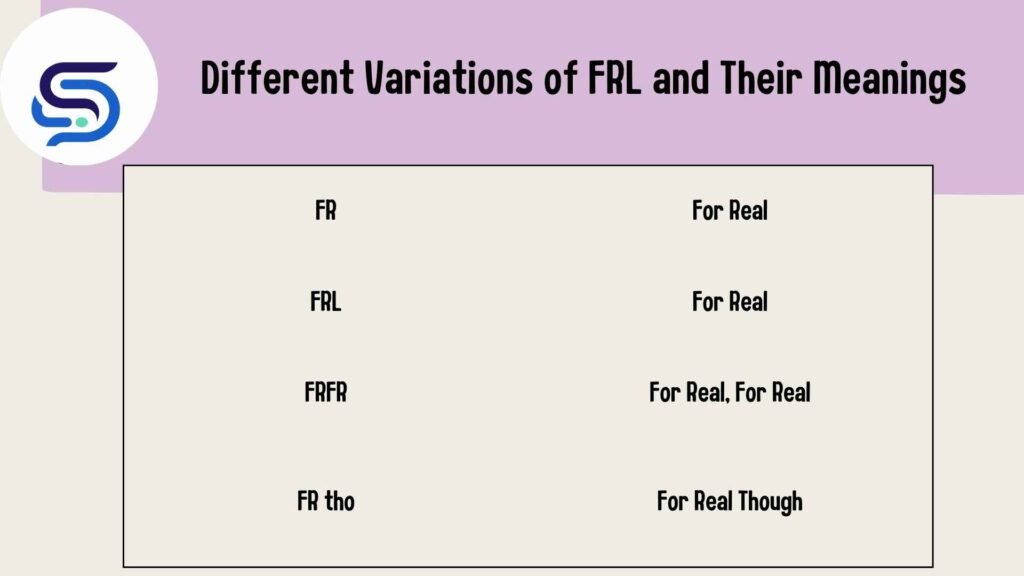
| Variation | Meaning | How It’s Used |
| FR | For Real | Used to show agreement or sincerity in a shorter form. |
| FRL | For Real | Emphasizes honesty or strong agreement in a message. |
| FRFR | For Real, For Real | Stronger emphasis, meaning someone is very serious or completely honest. |
| FR tho | For Real Though | Adds emphasis when agreeing strongly with a statement. |
| No FRL | Not For Real | Used jokingly or sarcastically to suggest something isn’t serious. |
How to Respond When Someone Uses FRL
When someone uses “FRL” (For Real) in a conversation, it typically indicates that they’re being genuine or expressing surprise. A good way to respond is to match that energy. If they’re agreeing with something you’ve said, you might want to build on that shared sentiment. For example, you could say, “Right? I know exactly what you mean!” or “Totally! It’s crazy to think about.”
For example:
Friend: “FRL, that game was incredible.”
You: “I know! The final level was amazing.”
Related: BBG Meaning
Similar Slang Terms and Alternatives
Casual Alternatives
In the realm of casual conversations, slang has evolved to include a myriad of playful alternatives that resonate with specific contexts. For instance, instead of saying “for real,” many people might throw in “fr fr” or “for real, for real” to emphasize their sincerity.
Examples include:
- FR – Short for “for real” and used in the same way as FRL.
- FRFR – Means “for real, for real,” showing strong emphasis or seriousness.
- No cap – Slang meaning “I’m telling the truth.”
- IKR (I Know, Right?) – Used to strongly agree with someone.
- Seriously – A simple word used to express genuine agreement.
Formal Alternatives
In formal conversations, the choice of language plays a pivotal role in establishing credibility and professionalism. Rather than relying on slang or acronyms like “FRL,” opt for expressions that convey sincerity while maintaining an appropriate tone. For instance, instead of saying, “I’m really looking forward to our meeting,” one might say, “I am eager to discuss our upcoming collaboration.”
Examples include:
- “Honestly”
- “Truly”
- “Genuinely”
- “In fact”
Professional Alternatives
In today’s professional landscape, the words we choose can profoundly impact our relationships and reputations. While abbreviations and slang may seem efficient — allowing for quick exchanges — they often lack the clarity and respect that formal communication demands. Using complete phrases not only enhances understanding but also demonstrates a commitment to professionalism.
Examples include:
- “To be honest.”
- “I completely agree.e”
- “That is absolutely correct.ct”
- “I genuinely believe this is true.”
Common Misunderstandings About FRL
One of the most prevalent common misunderstandings about FRL is the assumption that it maintains a universal meaning across all contexts. While it predominantly serves as shorthand for “for real” in the realm of casual texting and social media, its diverse applications in technical fields muddy the waters. In engineering, for instance, FRL can refer to Filter-Regulator-Lubricator units, crucial for maintaining pneumatic systems.
Read More: IGHT Meaning
Conclusion
Understanding the acronym FRL is crucial for effective communication in today’s digital discourse. As this article has illustrated, FRL signifies “for real,” and serves as a way to emphasize sincerity in conversations, particularly in text messaging and social media. Its usage has evolved over the years, reflecting the dynamic nature of language in the digital age.
Being aware of its origin and examples can enhance both your appreciation and use of digital slang. Stay informed and adaptable to continue engaging meaningfully in your chats; who knows what new acronyms will emerge next?
FAQs
What does FRL stand for?
FRL stands for “For Real Life,” often used to signify sincerity or authenticity in online conversations.
How is FRL used in text messaging?
FRL is commonly used to emphasize that something is genuine or serious, as in “I’m really going to start exercising, FRL.”
Where did the term FRL originate?
The term originated from online forums and social media, gaining popularity in the late 2000s and early 2010s as people sought to convey truthfulness.
Are there any variations of FRL?
Yes, variations include “FRFR” (For Real For Real) for added emphasis and “FR” (For Real), which is a more casual form.
Is FRL appropriate in formal communication?
No, FRL is considered informal and is best suited for casual texting or social media rather than professional or formal contexts.