CW Meaning in Text: Real Meaning, Examples & Social Media Use 2026
Abbreviations in chat can completely alter the meaning of a conversation. By 2026, understanding the meaning of abbreviations in text will be essential for navigating the dynamic world of social media.
As digital communication evolves, knowing their meanings and examples is crucial to avoiding misunderstandings. This article will give you a clear overview of CW Meaning in Text today’s context and how to use them correctly.
What Does CW Meaning in Text – Quick Meaning
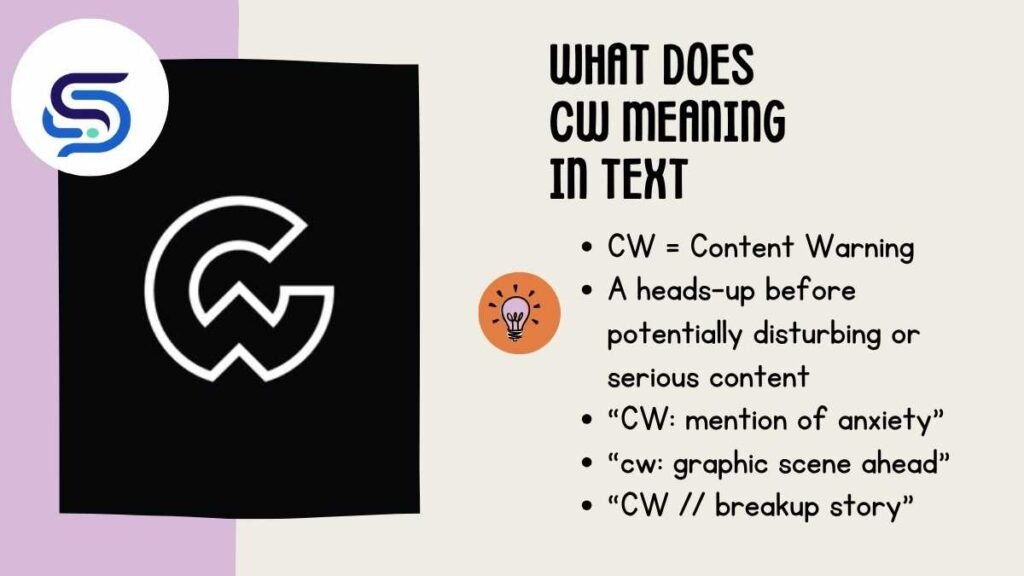
At its core, “CW” stands for “Content Warning.”
It’s used to alert someone that what follows may be sensitive, triggering, or emotionally intense.
Here we tell you some examples of CW Meaning in Text:
Simple Definition:
- CW = Content Warning
- A heads-up before potentially disturbing or serious content
Quick Examples:
- “CW: mention of anxiety”
- “cw: graphic scene ahead”
- “CW // breakup story”
Think of it as a digital way of saying: “Just so you know, this might be heavy.”
Background & History
The meaning of content warnings in texts has evolved significantly since their beginnings in online communities. In the early 2000s, platforms like Tumblr and fanfiction forums began setting precedents for creating a more inclusive environment.
Creators, aware that their works could trigger painful memories, introduced content warnings to protect those who had experienced trauma. In this sense, content warnings become an act of empathy, offering readers the opportunity to decide whether they want to expose themselves to content they might find disturbing.
Where People Use CW
TikTok
On TikTok, “CW” often appears in captions or on-screen text before a video starts. It lets viewers know the video includes sensitive topics.
Example:
CW: mentions of depression
Snapchat
On Snapchat, people use “CW” in stories before sharing personal or emotional content.
Example:
CW — talking about a bad day
On Instagram, you’ll see “CW” in captions, especially for posts discussing serious issues.
Example:
CW: body image discussion
In WhatsApp chats, it’s used before sending a message that might be heavy or emotional.
Example:
CW: I need to talk about something serious
SMS (Text Messages)
Even in regular texting, people use “CW” as a quick warning.
Example:
CW: tough topic ahead
Read Next: Hy Meaning in Text
Real Chat Examples
Here are 10 natural conversation examples:
- A: Hey, did you see my post?
B: Not yet
A: CW: It’s about mental health - A: I need to vent
B: Go ahead
A: CW: It’s kinda heavy - A: Watch this video
B: What’s it about?
A: CW: mentions anxiety - A: I posted something serious today
B: Oh?
A: Yeah, added a CW just in case - A: Can I talk?
B: Sure
A: CW: bad day at school - A: Sending you something
B: Okay
A: CW: emotional content - A: Check my story
B: What’s on it?
A: CW: personal stuff - A: I wrote a long message
B: I’m listening
A: CW: family issues - A: This post might be a lot
B: I’ll read it
A: I added a CW - A: Got something to say
B: Go for it
A: CW: stressful topic
How to Reply When Someone Says “CW”
When someone uses “CW,” they’re being thoughtful. Your reply can match their tone.
Funny Replies
- Got it, emotional seatbelt on
- Thanks for the warning, I’m ready
Casual Replies
- Okay, I’ll read it
- Thanks for the heads-up
Friendly Replies
- I’m here for you
- Take your time, I’ll listen
Neutral Replies
- Noted
- Thanks for letting me know
Emotional & Psychological Meaning
When someone uses “CW,” they’re doing more than sharing information.
They’re showing awareness.
They’re acknowledging that not everyone processes content the same way. What’s casual for one person might be deeply triggering for another.
Why People Use It
- To protect others emotionally
- To set boundaries
- To signal seriousness or sensitivity
- To build trust in communication
Is CW Rude or Offensive?
No, “CW” is not rude or offensive.
In fact, it’s the opposite. It shows consideration for others. People use it to avoid surprising someone with sensitive content.
It is generally:
- Safe to use in most online spaces
- Appropriate in school discussions (depending on context)
- Less common in formal workplace emails
In professional settings, people usually write the full phrase “Content Warning” instead.
Who Uses This Term?
“CW” is most commonly used by:
- Gen Z and younger millennials
- Active social media users
- Online communities focused on mental health or awareness
You’ll see it often on:
- TikTok
- Online forums
It appears regularly but mostly in specific contexts—especially when discussing serious or emotional topics.
Origin of the Term
“CW” comes from the phrase Content Warning, which has been used online for years.
It became popular through:
- Blogging platforms
- Online forums
- Social media communities
Over time, people shortened it to “CW” for faster typing.
The idea behind it is similar to “trigger warnings,” but “CW” is more general and widely accepted.
Read Also: WTM Meaning in Text
Usage in Different Contexts
Social Media
On platforms like Instagram, TikTok, or X:
- Used before heavy topics (mental health, trauma, violence)
- Often written as “CW:” or “CW //.”
Friends & Relationships
- Shows emotional awareness
- Helps avoid accidentally hurting someone
- Builds deeper trust
Work / Professional Settings
- Rare, but used in sensitive discussions (HR, counseling, journalism)
- More formal alternatives are often preferred
Casual vs Serious Tone
- Serious: “CW: grief discussion”
- Casual/light: “cw: embarrassing story incoming ”
Tone depends entirely on context.
When NOT to Use It
While “CW” is helpful, it’s not always appropriate.
Avoid using it:
- In formal business emails
- When it confuses more than clarifies
- If the content isn’t actually sensitive
- In urgent communication where clarity matters more than tone
Cultural Sensitivity
Not everyone understands “CW.” In some regions, it may feel unfamiliar or unnecessary.
Comparison Table
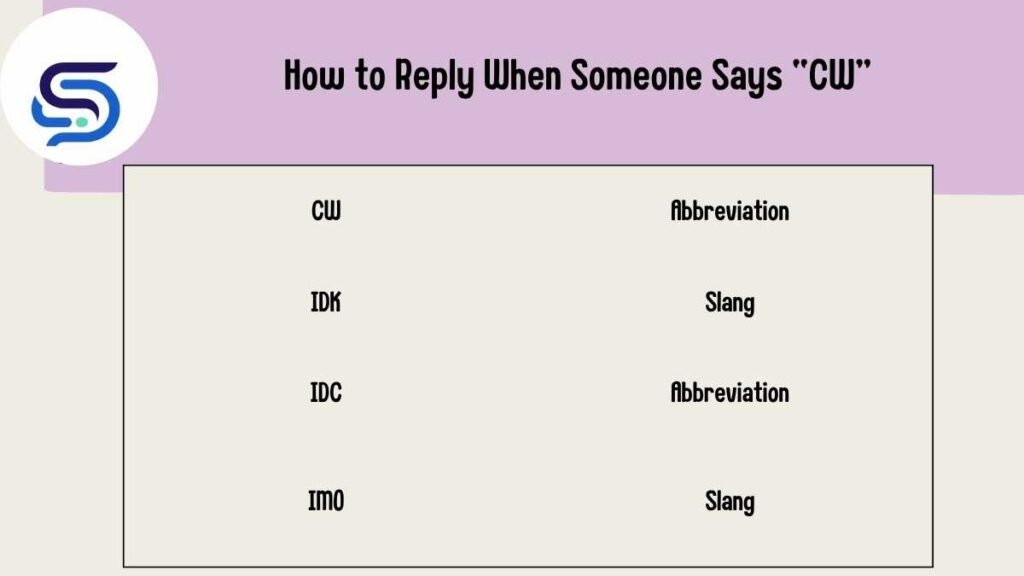
| Term | Meaning | Type | Usage | Popularity |
| CW | Content Warning | Abbreviation | Sensitive topics | Medium |
| IDK | I don’t know | Slang | Casual chat | Very High |
| IDC | I don’t care | Slang | Informal | High |
| IMO | In my opinion | Abbreviation | Opinions | High |
| BRB | Be right back | Slang | Chatting | High |
Variations / Types
Here are common variations you might see:
- CW: violence – Warning about violent content
- CW: anxiety – Mental health-related topic
- CW // breakup – Emotional relationship content
- cw: rant – Informal, emotional venting
- CW: graphic – Visual or descriptive intensity
- CW: hospital – Medical or illness-related content
- CW: grief – Loss or mourning
- CW: trauma mention – Sensitive past experiences
- cw: cringe story – Light, embarrassing content
- CW: sensitive topic – General caution
Read More: NK Meaning in Text
Conclusion
Understanding the CW Meaning in Text is essential for navigating modern communication, especially within social media platforms. As contexts evolve, so do the implications of abbreviations, making it vital to stay informed about their usage.
From content warnings to cultural references, the versatility of “CW” highlights its significance in fostering awareness and sensitivity among users. By recognizing how these terms impact conversations, we can engage more thoughtfully in digital spaces. Keep exploring the nuances of language in the ever-changing landscape of online communication!
FAQs
What does “CW” mean in text messaging?
CW typically stands for “Content Warning.” It alerts readers that the upcoming content may be sensitive or triggering.
Where is “CW” commonly used?
You can frequently find “CW” on social media platforms, online forums, and blogs, especially in discussions related to mental health, trauma, or sensitive topics.
How should I use “CW” in my own posts?
Place “CW” before the content that may be distressing, followed by a brief description of the subject matter (e.g., “CW: violence”).
Are there other meanings for “CW”?
Yes, “CW” can also mean “see also,” especially in academic or instructional contexts, but this is less common in casual texting.