Opposite of Benefit: Meaning, Examples, Synonyms & Usage
For every advantage, there often lurks a disadvantage. Exploring the opposite of benefit isn’t just an academic exercise; it’s a critical skill for anyone looking to make sound decisions in life and business.
In this article, we will unpack its meaning, provide relatable examples, and share useful synonyms and contexts for usage. By the conclusion, you will gain insights that allow you to balance benefits and drawbacks more effectively.
What Does Benefit Mean?
The term “benefit” encompasses both a noun and a verb, primarily signifying an advantage or positive outcome derived from a particular action, event, or circumstance. In everyday conversation, people often highlight benefits to underscore the positive aspects of a decision or activity.
For instance, when someone discusses the benefits of a healthy diet, they are referring to how proper nutrition can enhance energy levels, support immunity, and improve overall well-being.
What Is the Opposite of Benefit?
In addition to harm, another term that can be considered the opposite of benefit is “detriment.” Detriment refers specifically to something that causes loss or injury, which can manifest in various forms, such as emotional, physical, or financial disadvantages. While benefits enhance our lives or situations, detriments lower our quality of life or lead to unfavorable outcomes.
Furthermore, in certain contexts, “cost” or “drawback” can also serve as antonyms of benefit. Costs refer to sacrifices made to achieve something, often measured in terms of time, effort, or resources, while drawbacks highlight the negative aspects that accompany a decision or action.
Common Opposites of Benefit
Considering the common opposites of benefit, the word “harm” often stands out as the most immediate antonym. Harm encompasses a wide range of negative consequences, whether physical, emotional, or psychological. By recognizing harm, we can better appreciate the value of benefits in various aspects of life, such as health and relationships.
Another essential term in this realm is “disadvantage,” which encapsulates unfavorable conditions that can arise from decisions or actions. Disadvantages are often subtle yet impactful, altering the outcomes of our choices in profound ways. Likewise, “loss” signifies the removal of something valuable, stirring feelings of regret and prompting introspection about what we consider beneficial.
Harm as the Main Opposite of Benefit
Exploring the dichotomy between harm and benefit, it becomes clear that the implications of harm extend far beyond individual experiences. In striving for progress, be it in technology, business, or lifestyle choices, neglecting the potential for harm can have widespread repercussions.
For instance, the environmental degradation stemming from unchecked industrial growth serves as a stark reminder that the pursuit of profit can lead to dire consequences for ecosystems and communities alike. This highlights the need for a balanced approach, where benefits must be carefully weighed against potential harms.
Difference Between Benefit and Harm
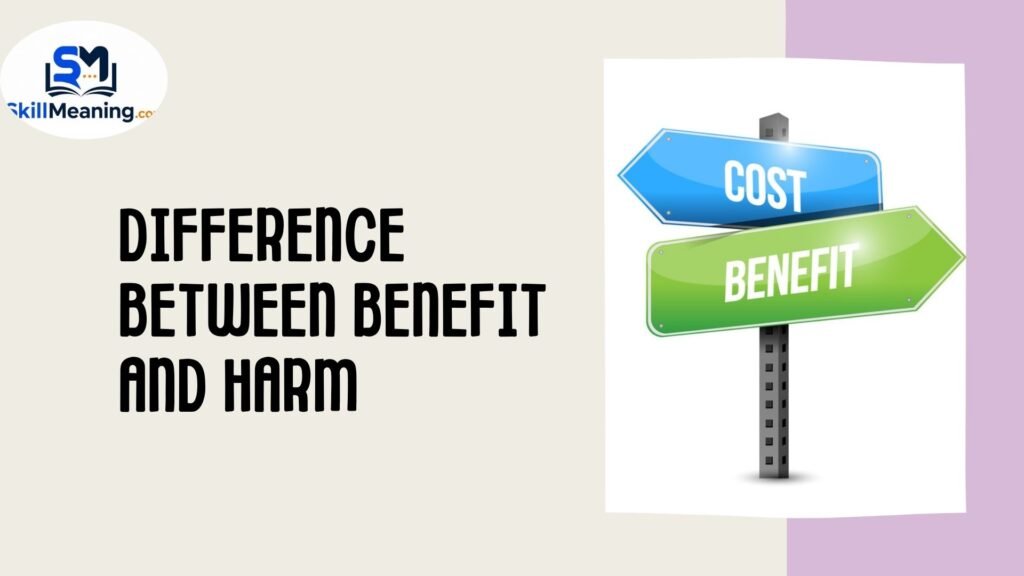
The distinction between benefit and harm is foundational to understanding choices in our daily lives. When we focus on benefits, we open ourselves to opportunities, whether in health, relationships, or personal development. For instance, practicing mindfulness can enhance mental clarity and emotional resilience, leading to a more fulfilled existence. This proactive approach to well-being fosters a mindset that seeks improvement and growth.
Benefit vs Disadvantage
Weighing benefits against disadvantages, it’s crucial to recognize that they often exist in tandem, shaping our experiences and decisions. For example, the rise of online education provides the significant benefit of accessibility, allowing learners from diverse backgrounds to engage with top-notch programs.
Yet, this same shift can lead to a diluted educational experience, in which personal interaction and immediate feedback may fall short compared to traditional classrooms.
Read Next: BD Meaning in Text
Benefit vs Loss
In the intricate dance of decision-making, understanding the balance between benefit and loss is essential. Consider a business that invests in employee training programs. The immediate cost may seem daunting, yet the long-term benefits manifest as improved performance, higher employee satisfaction, and lower turnover rates. This ripple effect illustrates how an initial investment can yield significant returns, underlining the importance of foresight in evaluating potential outcomes.
Benefit vs Damage
The interplay between benefit and damage serves as a crucial lens through which we assess our decisions. Take, for instance, the act of investing time in personal development. While diving into new skills can enhance career prospects and self-esteem, neglecting this growth can lead to stagnation — a form of emotional damage that quietly erodes potential. This duality emphasizes that our incremental choices can have far-reaching implications, often manifesting in ways we might not immediately recognize.
Examples of Opposite of Benefit in Sentences
- Exercise provides benefits to overall health.
- Smoking causes harm to the lungs.
- Good education benefits society.
- Crime creates disadvantages for communities.
- Careful planning brings benefits.
- Poor decisions may result in losses.
Synonyms of Benefit
Exploring synonyms of “benefit” not only enhances your vocabulary but also adds nuance to your communication. For instance, the term “advantage” suggests a competitive edge, often in contexts such as sports or business, where one seeks to outperform others. On the other hand, “gain” implies an accumulation, whether it be knowledge, wealth, or personal growth, subtly shifting the focus from the act of benefitting to the result of that benefit.
Synonyms of Harm
The exploration of synonyms for “harm” reveals a rich tapestry of language that captures the nuances of damage in our lives. For instance, “detriment” not only implies injury but also hints at broader implications — a setback that might affect long-term growth or progress. Similarly, the term “impairment” suggests a weakening, often associated with health or functionality, emphasizing the vulnerability that can accompany any form of harm.
Why Learning Opposites Improves Vocabulary
Learning opposites, or antonyms, plays a crucial role in enhancing vocabulary because it deepens our understanding of word relationships. When we learn a new word, knowing its opposite provides a clearer context and helps solidify its meaning in our minds.
For example, understanding “hot” not only helps us grasp its definition but also allows us to appreciate the concept of “cold.” This structured relationship facilitates better memory retention and enables more precise communication.
Opposite of Benefit in Academic Writing
In academic writing, the term “benefit” frequently denotes the positive outcomes of a study or argument, while the carefully selected opposite, “disadvantage,” captures the essence of negative impacts. This careful balance is not just a matter of lexical choice; it reflects a deeper engagement with the complexities of your subject matter.
How to Choose the Correct Opposite
Choosing the correct opposite indeed hinges on the context in which you’re communicating. For instance, when addressing physical injuries, using “harm” emphasizes the severity and impact on well-being. In contrast, when discussing less tangible concepts like unfavorable conditions, “disadvantage” paints a clearer picture of competitive or situational drawbacks.
In financial discussions, “loss” effectively represents the opposite of gain, capturing the essence of negative financial outcomes. Similarly, when referring to destruction, “damage” can communicate the degree of impact more accurately.
Read Also: IKYFL Meaning in Text
Common Mistakes When Using Opposites of Benefit
When discussing the opposites of benefits, many people default to “harm,” but this can oversimplify complex situations. Depending on the context, words like “drawback,” “downside,” or “cost” may resonate more accurately.
For instance, in business discussions, it’s beneficial to refer to potential drawbacks of a strategy rather than simply labeling them as harm. This subtle shift in terminology encourages a balanced view and invites constructive dialogue.
Moreover, the choice of antonym can influence perceptions. Saying someone has experienced a “loss” might connote emotional absence, while “damage” suggests a more physical impairment, yet often these terms are used interchangeably.
Important Opposite Words List
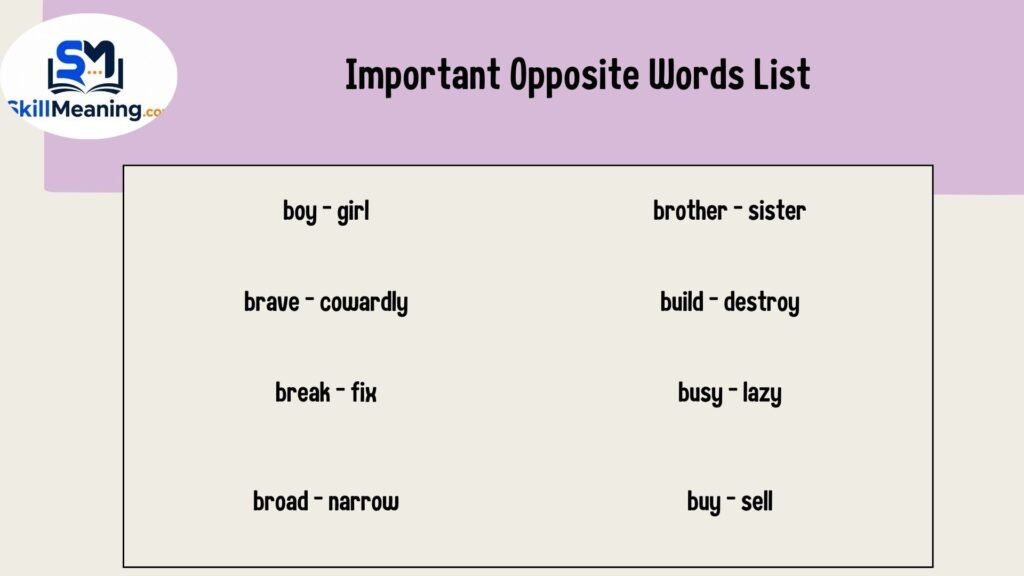
- boy – girl
- brave – cowardly
- break – fix
- broad – narrow
- brother – sister
- build – destroy
- busy – lazy
- buy – sell
- calm – excited
- careful – careless
- careless – careful
- catch – miss
- ceiling – floor
- cellar – attic
- centre – outskirts
- certainly – probably
- changeable – constant
- cheap – expensive
- child – adult
- children – parents
- clean – dirty
- clear – cloudy
- clever – stupid
- close – open
- closed – open
- cloudy – clear
- cold – hot
- cold – heat
- come – go
- comedy – drama
- complicated – simple
- compliment – insult
- compulsory – voluntary
- connect – separate
- consonant – vowel
- constant – changeable
- cry – laugh
- damage – repair
- danger – security
- dangerous – safe
- dark – light
- daughter – son
- dawn – dusk
- day – night
- dead – alive
- death – birth
- deep – shallow
- defeat – victory
- defence – attack
- defend – attack
- delicious – awful
- deny – admit
- depart – arrive
- departure – arrival
- descendant – ancestor
- descent – ascent
- desperate – hopeful
- destroy – build
- destruction – construction
- devil – angel
- dictatorship – republic
- die – live
- emigrate – immigrate
- emigration – immigration
- empty – full
- end – begin
- end – beginning
- ending – beginning
- enemy – friend
- enjoy – hate
- enter – leave
- entrance – exit
- equal – different
- even – odd
- evening – morning
- everybody – nobody
- everything – nothing
Synonym for Benefit
- utility
- use
- advantage
- usefulness
- profit
- efficacy
- avail
- gain
- advance
- vantage
- head start
- odds
- winnings
- earnings
- income
- expediency
- stake
- expedience
Read More: TSTS Meaning in Text
Conclusion
Understanding the opposite of “benefit” provides a deeper insight into language and the nuances of meaning. Words like “detriment,” “harm,” and “disadvantage” highlight the potential pitfalls and challenges we face in various contexts.
Recognizing these terms allows us to better articulate the adverse effects that can arise from decisions and actions. Whether in personal choices or professional environments, evaluating both benefits and drawbacks is crucial. As you navigate your own experiences, consider not just the positives but also the negatives to make more informed decisions.
FAQs
What is the opposite of “benefit”?
The opposite of “benefit” is “detriment,” which refers to a harmful or disadvantageous effect.
Can you give examples of detriments?
Examples include health issues from smoking, decreased productivity from distractions, and financial losses from poor investments.
What are some synonyms for “detriment”?
Some synonyms include harm, disadvantage, loss, drawback, and impairment.
How can “detriment” be used in a sentence?
An example sentence is: “The new policy could lead to a detriment in employee morale.”
Are there any idiomatic expressions related to detriment?
Yes, phrases like “to one’s detriment” or “to the detriment of” indicate a negative impact on someone or something.