230+ Science Words That Start With G: Best Guide With Meanings, Examples & Terms
A simple letter can unlock a universe of scientific vocabulary. In the realm of science, words that start with “G” are not just letters — they represent concepts, theories, and discoveries that shape our understanding of the natural world.
This article delves into over 230 science words that start with G, providing meanings, examples, and relevant terms. Whether you’re a student, educator, or simply a science enthusiast, this comprehensive guide will enrich your vocabulary and enhance your appreciation of science.
Why Do Science Words Starting With G Matter?
Science words starting with the letter “G” matter for several reasons, particularly in the realm of clarity and specificity in scientific communication. Terms like “gene,” “gravity,” and “germ” are foundational concepts across various scientific disciplines. Each of these words encapsulates complex ideas that are essential for understanding broader subjects in biology, physics, and health science, respectively.
Physics Science Words That Start With G
Gravity, a fundamental force, enthralls both scientists and casual observers alike. It shapes planetary orbits, dictates ocean tides, and even influences how we experience time. The elegance of gravity lies in its simplicity and omnipresence; every object with mass attracts every other object, weaving an intricate dance across the cosmos. Imagine standing on Earth, aware that the very ground you are on is engaging in a celestial ballet with the moon and the sun.
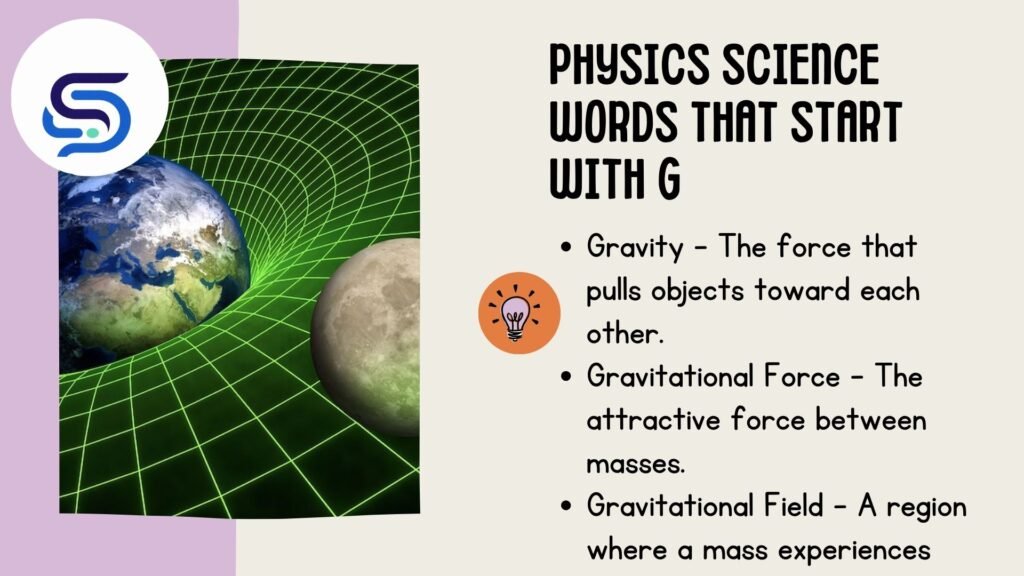
- Gravity – The force that pulls objects toward each other.
- Gravitational Force – The attractive force between masses.
- Gravitational Field – A region where a mass experiences gravitational force.
- Gravitational Potential Energy – Energy stored due to an object’s position in a gravitational field.
- Gradient – The rate of change of a physical quantity.
- Gyroscope – A device that maintains direction using rotational motion.
- Geometric Optics – The study of light propagation using rays.
- Galvanometer – An instrument that detects small electric currents.
- Gauss’s Law – A law that relates electric flux to charge.
- Gauss (Unit) – A unit of magnetic flux density.
- Gamma Rays – High-energy electromagnetic radiation.
- Grounding – The process of transferring electric charge to Earth.
- Gauge Pressure – Pressure measured relative to atmospheric pressure.
- General Relativity – Einstein’s theory describing gravity as spacetime curvature.
- Gibbs Free Energy (Physics Use) – A measure of useful energy in thermodynamic systems.
- Gluon – A particle that carries the strong nuclear force.
- Geodesic – The shortest path in curved spacetime.
- Galilean Transformation – A set of equations relating motion in classical mechanics.
- Gradient Force – A force caused by spatial changes in field strength.
- Gyromagnetic Ratio – Ratio of magnetic moment to angular momentum.
Chemistry Science Words That Start With G
In the realm of chemistry, the letter “G” unlocks a trove of fascinating concepts and terminologies that deepen our understanding of the microscopic world. One such term is “group,” referring to columns in the periodic table that share similar chemical properties. This collective behavior creates a bond among elements, shaping their reactivity and interactions.
- Gas – A state of matter with no fixed shape or volume.
- Gasoline – A liquid fuel mixture derived from petroleum.
- Glucose – A simple sugar and key energy source.
- Glycerol – A sweet, viscous alcohol used in chemical reactions.
- Galvanization – Coating metal with zinc to prevent corrosion.
- Geochemistry – The study of chemical processes in Earth materials.
- Gibbs Free Energy – The energy available for work in chemical reactions.
- Glycol – An organic compound used as an antifreeze and solvent.
- Gravimetric Analysis – A method of measuring substances by mass.
- Group (Periodic Table) – A vertical column of elements with similar properties.
- Ground State – The lowest energy level of an atom.
- Gamma Radiation – High-energy radiation emitted during nuclear decay.
- Green Chemistry – Chemical practices that reduce environmental harm.
- Glycosidic Bond – A bond connecting sugar molecules.
- Glass – A non-crystalline solid made mainly of silica.
- Gas Chromatography – A technique for separating chemical mixtures.
- Gold – A chemical element with atomic number 79.
- Galactose – A simple sugar related to glucose.
- Guanine – A nitrogenous base found in DNA and RNA.
- Graphene – A single layer of carbon atoms with unique properties.
Medical & Health Science Words That Start With G
- Gastroenterology – The study of the digestive system and its disorders.
- Glucose – A simple sugar that provides energy to the body.
- Gastrointestinal Tract – The digestive pathway from the mouth to the anus.
- Genetic Disorder – A disease caused by abnormalities in genes or chromosomes.
- Geriatrics – The branch of medicine focused on elderly health.
- Gland – A structure that produces and secretes hormones or fluids.
- Gout – A painful condition caused by uric acid crystal buildup.
- Gingivitis – Inflammation of the gums.
- Glaucoma – An eye disease that damages the optic nerve.
- Gallbladder – An organ that stores bile for digestion.
- Gastritis – Inflammation of the stomach lining.
- Gene Therapy – Treatment that involves altering genes to cure disease.
- Gestation – The period of development during pregnancy.
- Granuloma – A small cluster of inflammatory cells.
- Geriatric Medicine – Medical care specifically for older adults.
- Gastroplasty – Surgery performed to treat obesity or stomach disorders.
- Gluconeogenesis – The creation of glucose from non-carbohydrate sources.
- Gynecology – The medical specialty dealing with women’s reproductive health.
- Germ Theory – The scientific theory that microorganisms cause disease.
- Gaze Stabilization – The ability of the eyes to keep images steady during movement.
Technology & Applied Science Words With G
- GPS (Global Positioning System) – A satellite-based navigation system.
- Gigabyte – A unit of digital storage equal to one billion bytes.
- Graphics Card – Hardware that processes visual output in computers.
- Grid Computing – Using connected computers to solve large problems.
- GUI (Graphical User Interface) – A visual interface with icons and menus.
- Gyroscope Sensor – A device that detects orientation in phones and machines.
- Governance Algorithm – A system that controls automated decision-making.
- Geofencing – Technology that uses GPS to create virtual boundaries.
- G-code – Programming language used for controlling CNC machines.
- Game Engine – Software for developing video games.
- Gigahertz – A measure of frequency equal to one billion cycles per second.
- Green Technology – Technology designed to reduce environmental impact.
- Genetic Engineering – Modifying DNA for technological or medical use.
- Gesture Recognition – Technology that interprets human movements.
- Grid System – A network of interconnected electrical power lines.
- Gas Sensor – A device that detects the presence of gases.
- Gateway – A network device connecting different systems.
- Graph Database – A database that stores data in nodes and relationships.
- Ground Robot – A robot designed for land-based tasks.
- Gigafactory – A large facility for mass-producing batteries or tech components.
Read Also: 250+ Science Words That Start With C
Biology Science Words That Start With G
- Gene – A unit of heredity that carries genetic information.
- Genetics – The study of genes and inheritance.
- Genotype – The genetic makeup of an organism.
- Genome – The complete set of genes in an organism.
- Germination – The process by which a seed grows into a plant.
- Germ Cell – A reproductive cell, such as sperm or eggs.
- Golgi Apparatus – An organelle that modifies and packages proteins.
- Gland – An organ that secretes hormones or other substances.
- Glucose – The main sugar used for energy in cells.
- Glucagon – A hormone that raises blood sugar levels.
- Glycogen – A stored form of glucose in the body.
- Gametogenesis – The process of forming reproductive cells.
- Growth Hormone – A hormone that stimulates growth and development.
- Granulocyte – A type of white blood cell with granules.
- Gills – Organs that allow aquatic animals to obtain oxygen.
- Gut Microbiome – Microorganisms living in the digestive tract.
- Gene Expression – The process by which genes produce proteins.
- Genetic Drift – Random changes in gene frequency in a population.
- Gymnosperms – Seed-producing plants such as conifers.
- Glycolysis – The metabolic pathway that breaks down glucose.
Forensic Science Words With G

- Gunshot Residue (GSR) – Tiny particles left behind after a gun is fired.
- Genetic Fingerprinting – Using DNA to identify individuals.
- Glass Fracture Analysis – Studying broken glass to reconstruct crime events.
- Gas Chromatography – A method to separate and analyze chemicals.
- Gunpowder – An explosive substance often tested in forensic cases.
- Gait Analysis – Examining walking patterns to identify suspects.
- Glove Prints – Marks left by gloves at a crime scene.
- Gravitational Pull Analysis – Using soil or particles to determine the movement of evidence.
- GSR Testing – Testing hands, clothes, or objects for gunshot residue.
- Genetic Markers – DNA sequences used to identify individuals.
- Grave Soil Analysis – Examining soil near human remains.
- Glass Beads Test – Identifying explosive residues in crime labs.
- Gastric Contents Analysis – Examining stomach contents to determine time of death.
- Gunshot Wound Analysis – Studying bullets and wounds for investigation.
- Geolocation Data – Using digital location information as evidence.
Astronomy & Space Science With G
- Galaxy – A vast system of stars, gas, and dust bound by gravity.
- Galactic Core – The central region of a galaxy.
- Galilean Moons – The four largest moons of Jupiter discovered by Galileo.
- Gamma-Ray Burst – A powerful explosion emitting intense gamma radiation.
- Geocentric Model – The ancient idea that Earth is the center of the universe.
- Gravity Well – A region where gravity pulls strongly on objects.
- Gravitational Lens – Light bending around massive objects.
- Gravitational Waves – Ripples in spacetime caused by massive bodies.
- Geosynchronous Orbit – An orbit in which a satellite stays over the same spot on Earth.
- Geostationary Satellite – A satellite fixed above the equator in a constant position.
- Gas Giant – A large planet made mostly of gases like Jupiter or Saturn.
- Globe – A spherical model representing Earth or other planets.
- Great Red Spot – A giant storm on Jupiter.
- Galactic Halo – A region of stars and dark matter surrounding a galaxy.
- Galactic Year – The time it takes the Sun to orbit the Milky Way.
- Granulation – The mottled pattern on the Sun’s surface is caused by hot plasma movement.
- Globular Cluster – A dense group of old stars.
- Gyrochronology – Measuring a star’s age based on rotation.
- Gas Cloud – A large collection of gas in space, often forming stars.
- Goldilocks Zone – The habitable zone around a star where liquid water can exist.
Math Science Words That Start With G
- Geometry – The branch of math dealing with shapes, sizes, and space.
- Graph – A diagram showing relationships between numbers or data.
- Gradient – The slope or steepness of a line.
- Greatest Common Divisor (GCD) – The largest number that divides two or more numbers.
- Geometric Sequence – A sequence where each term is multiplied by a constant.
- Grid – A network of horizontal and vertical lines used for plotting points.
- Group (Algebra) – A set with an operation that follows specific rules.
- Geodesic – The shortest path between two points on a curved surface.
- Golden Ratio – A special number (~1.618) often seen in art and nature.
- General Term – A formula used to find any term in a sequence.
- Gaussian Distribution – A bell-shaped probability curve.
- Greatest Integer Function – A function that rounds a number down to the nearest integer.
- Geometric Mean – The central tendency of numbers found by multiplying and taking roots.
- Graph Theory – A branch of math studying networks and connections.
- Gaussian Elimination – A method for solving systems of equations.
Easy Science Words That Start With G
| Word | Description |
| Gas | Matter that spreads to fill any space. |
| Gold | A shiny yellow metal used in jewelry. |
| Grass | A common green plant found in fields and gardens. |
| Grow | To increase in size or develop. |
| Ground | The solid surface of the Earth. |
| Grain | A small, hard seed or particle. |
| Germ | A tiny organism that can cause sickness. |
| Glue | A sticky substance used to join things. |
| Geyser | Hot water that shoots out of the ground. |
| Giant | Something very large in size. |
| Group | A number of things or people together. |
| Gravel | Small stones used for construction or paths. |
| Globe | A round model of Earth. |
| Gravity | The force that pulls things down. |
| Gills | Organs fish use to breathe underwater. |
| Gum | A soft tissue around the teeth. |
| Gasoline | A liquid fuel for cars. |
| Galaxy | A large system of stars in space. |
| Glow | To give off light. |
| Groom | To clean or care for an animal’s body. |
Advanced & Technical Science Words With G
- Geosynchronous Orbit – An orbit where a satellite matches Earth’s rotation.
- Gluconeogenesis – The synthesis of glucose from non-sugar materials.
- Geochemistry – The study of Earth’s chemical composition and processes.
- Gyrochronology – Estimating a star’s age based on its rotation rate.
- Gravitational Lensing – The bending of light by massive objects.
- Genome Sequencing – Determining the order of DNA bases in an organism.
- Geotechnical Engineering – Applying soil and rock science to construction.
- Gastrointestinal Physiology – The study of digestive system functions.
- Gametophyte – The haploid phase in plant life cycles.
- Gibbs Free Energy – A thermodynamic quantity measuring usable energy.
- Geospatial Analysis – Studying data linked to geographic locations.
- Glaciology – The study of glaciers and ice sheets.
- Gyroscope Dynamics – The study of rotating bodies and angular momentum.
- Geomagnetic Reversal – A change in Earth’s magnetic field direction.
- Galvanic Cell – A device that generates electricity through chemical reactions.
- Gas Chromatography – A method for separating chemical mixtures.
- Gene Expression Profiling – Measuring how genes are activated or suppressed.
- Granulomatous Inflammation – A specific chronic inflammatory response.
- Gravimetry – Measuring gravitational fields and variations.
- Geoneutrinos – Subatomic particles produced inside Earth by radioactive decay.
Earth Science Words Starting With G
- Geology – The study of Earth’s structure, rocks, and history.
- Glacier – A large, moving mass of ice on land.
- Geyser – A natural hot spring that shoots water and steam into the air.
- Groundwater – Water stored underground in soil and rocks.
- Granite – A common type of hard igneous rock.
- Geosphere – The solid parts of Earth, including rocks and landforms.
- Geomorphology – The study of landforms and Earth’s surface processes.
- Geothermal Energy – Heat energy from inside the Earth.
- Gas Hydrates – Icy compounds containing gas found under the sea floor.
- Global Warming – The rise in Earth’s average temperature.
- Greenhouse Effect – The trapping of heat in Earth’s atmosphere.
- Geochronology – The science of dating rocks and fossils.
- Gondwana – An ancient supercontinent that existed millions of years ago.
- Graben – A block of land that has dropped between faults.
- Gypsum – A soft mineral used in making plaster and drywall.
Earth & Environmental Science Words Starting With G
- Geology – The study of Earth’s rocks, layers, and structure.
- Geography – The science of Earth’s landscapes, climates, and features.
- Geothermal Energy – Heat energy generated from beneath Earth’s surface.
- Greenhouse Effect – The warming of Earth due to trapped heat in the atmosphere.
- Glacier – A massive body of moving ice formed from compacted snow.
- Groundwater – Water stored underground in soil and rock layers.
- Geosphere – The solid part of Earth, including rocks and landforms.
- Geyser – A natural hot spring that erupts steam and hot water.
- Granite – A common igneous rock made of quartz, feldspar, and mica.
- Gully Erosion – Soil removal caused by running surface water.
- Geomorphology – The study of landforms and the processes shaping them.
- Gas Emissions – Gases released into the atmosphere from natural or human sources.
- Global Warming – The long-term rise in Earth’s average temperature.
- Grassland – A large ecosystem dominated by grasses.
- Geochemical Cycle – The movement of elements through Earth’s systems.
- Granulation Soil – Soil with a crumb-like texture.
- Gorge – A narrow, deep valley carved by rivers.
- Geochronology – The science of determining the age of rocks.
- Global Circulation – Large-scale movement of air around the planet.
- Ground Pollution – Contamination of soil by harmful substances.
Read More: 220+ Science Words That Start With Y
Scientific Words Starting With G
| Word | Meaning |
| Gravity | The force pulling objects toward each other. |
| Galaxy | A system of stars and planets. |
| Geography | The study of Earth’s surface and features. |
| Geology | The science of rocks and the Earth. |
| Greenhouse Effect | The trapping of heat in Earth’s atmosphere. |
| Genetic Engineering | Changing DNA to create desired traits. |
| Geothermal Energy | Energy from Earth’s internal heat. |
| Germ Theory | The idea that diseases are caused by microorganisms. |
| Gyroscope | A tool for measuring or maintaining direction. |
| Gradient | A measure of how much something changes over distance. |
| Global Warming | The rise in Earth’s average temperature. |
| Gas Laws | Rules that explain how gases behave. |
| Galileo Galilei | A famous scientist known as the father of modern physics. |
| Genomics | The study of entire sets of genes. |
| Groundwater | Water found underground in soil and rock. |
Conclusion
The comprehensive list of 230+ science words that start with the letter “G” provides a valuable resource for students, educators, and science enthusiasts alike. Each term comes with detailed meanings and examples, making it easier to grasp complex concepts that are often encountered in various scientific fields.
By familiarizing yourself with these terms, you can enhance your vocabulary and improve your understanding of science at a deeper level. Whether you’re preparing for an exam or simply igniting your curiosity, this guide will serve as an essential reference point. Dive into the world of science and start exploring these fascinating terms today!
FAQs
What is the purpose of the guide on science words that start with G?
The guide aims to help readers understand and utilize scientific terminology beginning with the letter G, providing definitions, examples, and context.
Are the terms included in the guide suitable for all ages?
Yes, the terms range from basic to advanced, making them accessible for students, educators, and science enthusiasts of all ages.
How are the terms organized in the guide?
The terms are organized alphabetically along with their meanings and relevant examples to facilitate easy navigation.
Can I find examples of usage for each term?
Absolutely! Each term is accompanied by practical examples that illustrate its application in real-world science contexts.
Is the guide regularly updated?
Yes, the guide is regularly reviewed and updated to include new terminology and ensure accuracy.